

Introduction to Real-time Performance Dashboards
In contemporary business settings, organizations often seek effective ways to manage complex data and make timely decisions. Real-time performance dashboards offer a solution by providing a dynamic view of an organization’s key operational metrics. These dashboards are designed to aggregate data from multiple sources, allowing users to monitor essential indicators as they change.
The core purpose of these dashboards is to enhance operational visibility. By presenting intricate data in a clear, digestible format, they enable stakeholders to understand current performance swiftly. This immediate access to insights supports informed decision-making, which can contribute to overall business success.
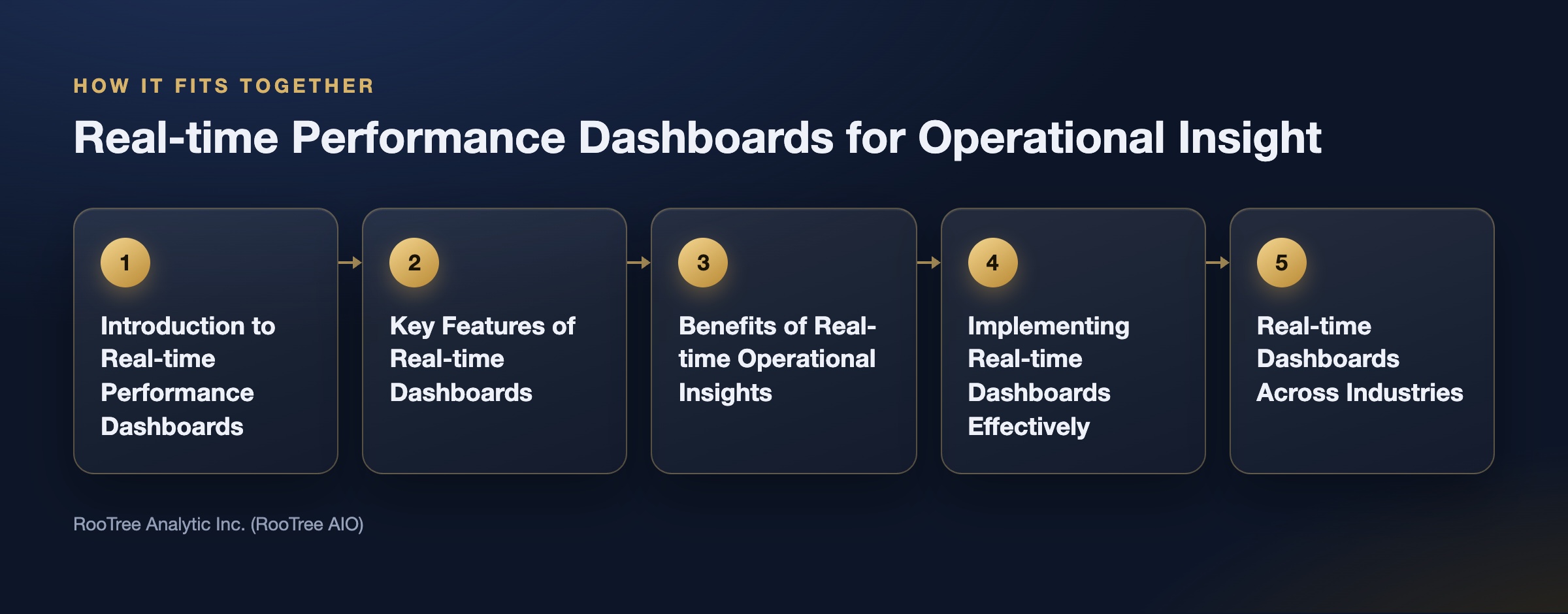
Key Features of Real-time Dashboards
Effective real-time performance dashboards typically come equipped with several features that contribute to their utility and user experience:
- Interactive Data Visualizations: Users can engage with charts, graphs, and other visual representations of data. This interactivity allows for deeper exploration and analysis of metrics, moving beyond static reports to uncover specific trends or anomalies.
- Real-Time Data Aggregation and Access: These dashboards are designed to pull data from diverse systems and present it without significant delays. This ensures that the information users view reflects the most current operational status, enabling immediate responses to evolving situations.
- Customizable Reporting: The ability to tailor reports is crucial for addressing specific business requirements. Users can define which metrics are most relevant to their objectives and create focused reports that highlight these areas, providing flexibility in how data is consumed.
- Predictive Analysis Capabilities: Some dashboards incorporate advanced analytical functions that can help anticipate future trends based on historical and current data. This supports a proactive approach to planning and strategy development, rather than solely reacting to past events.
- Cloud Accessibility: Many modern dashboard solutions are cloud-based. This architectural choice offers flexibility, allowing authorized users to access their operational insights from various locations and devices, fostering collaboration and supporting remote work arrangements.
Benefits of Real-time Operational Insights
The adoption of real-time performance dashboards can bring several advantages to an organization’s operations:
- Informed Decision-Making: Access to current data allows decision-makers to react promptly to changes in market conditions, operational performance, or other relevant factors. This responsiveness can be key in dynamic environments.
- Improved Operational Efficiency: By centralizing and visualizing data, dashboards can simplify the process of monitoring performance. This often reduces the time and resources previously spent on manual data collection and report generation, streamlining analytical workflows.
- Enhanced Business Intelligence: These tools provide a consolidated view of an organization’s activities, offering a broader and deeper understanding of business performance. This comprehensive insight helps identify areas for improvement and opportunities for growth.
- Supporting Data Quality: Reliable data is foundational for accurate insights. Poor data quality can have significant consequences. For instance, Gartner (2018) estimated that poor data quality costs organizations an average of $15 million per year. Furthermore, spreadsheet research summarized by PSP IT reports that close to 90% of spreadsheets contain errors, highlighting a common source of data issues. In one notable instance, JPMorgan’s 2012 ‘London Whale’ trading loss of about $6 billion was linked in part to a risk model maintained in spreadsheets with manual copy-and-paste steps. Real-time dashboards, when integrated with robust data governance, can help mitigate such risks by working with cleaner, validated data sources.
- Scalability for Growth: As organizations evolve, their data needs often expand. Dashboard solutions are typically designed to accommodate new data sources and metrics, ensuring that the system can grow alongside the business without requiring complete overhauls.

Implementing Real-time Dashboards Effectively
To successfully integrate real-time performance dashboards into an organization’s workflow, a thoughtful approach to implementation is beneficial:
- Phased Implementation: Consider starting with a pilot project focused on a specific department or set of metrics. This allows the organization to test the dashboard’s functionality and effectiveness on a smaller scale before a broader deployment. Learning from this initial phase can inform and improve subsequent rollouts.
- Focus on Data Quality: The accuracy of insights derived from a dashboard directly depends on the quality of the underlying data. Prioritize initiatives for data cleansing, validation, and establishing consistent data input processes. High-quality data is essential for reliable reporting and analysis.
- Selecting Suitable Tools: Choose a dashboard solution that aligns with the organization’s specific operational needs and can integrate with existing data systems. Some providers, such as RooTree Analytic Inc., offer specialized AI-first business intelligence and data analytics solutions tailored for sectors like finance, insurance, lending, distribution, and SMEs. These platforms, including RooTree Plus, are designed to consolidate data into a single source of truth with live dashboards and row-level security. RooTree Analytic Inc., incubated by Toronto Business Development Centre, is also ISO/IEC 27001:2022 certified, highlighting its commitment to information security.
- User Training: Provide comprehensive training for all employees who will be using the dashboards. This ensures they can effectively navigate the system, interpret the data presented, and leverage its features to support their daily tasks and decision-making.
- Leveraging Cloud Infrastructure: Utilizing cloud-based platforms for dashboard deployment can offer benefits in terms of flexibility, scalability, and ease of access. Cloud solutions can simplify maintenance and updates, allowing teams to focus on data utilization rather than infrastructure management.
Real-time Dashboards Across Industries
The versatility of real-time performance dashboards means they can be adapted to serve diverse needs across various sectors:
- Finance and Insurance: These industries often benefit from real-time monitoring of financial transactions, risk indicators, and customer service metrics. For financial institutions, dashboards can track transaction volumes and fraud detection alerts. In insurance, they can help monitor claims processing times or policy issuance rates. Solutions like those for finance and insurance provided by RooTree Analytic Inc. aim to offer specialized analytics and dashboards, including V-Insure for insurance field operations.
- Retail and Distribution: Businesses in these sectors can use dashboards to oversee inventory levels, sales performance, and supply chain logistics. Real-time data on product movement and customer demand can inform stock replenishment strategies and optimize store operations.
- Manufacturing: In manufacturing, dashboards are valuable for tracking production line efficiency, equipment performance, and quality control metrics. Monitoring these in real time can help identify bottlenecks or potential machine failures, enabling proactive maintenance and minimizing downtime.
- Healthcare: Healthcare providers can utilize dashboards to track patient flow, resource allocation, and key clinical outcomes. This can contribute to improving operational efficiency within hospitals or clinics and supporting patient care coordination.
FAQ
What defines a real-time performance dashboard?
A real-time performance dashboard is a data visualization tool that collects and displays operational data as it becomes available. Its key characteristic is the minimal delay between data generation and its presentation, offering an up-to-the-moment view of performance metrics.
How do real-time dashboards support decision-making?
By providing immediate access to current data, real-time dashboards enable decision-makers to identify trends, anomalies, and critical issues as they unfold. This allows for swift, informed responses, whether it involves adjusting strategies, reallocating resources, or addressing potential problems before they escalate.
What should organizations consider when implementing a real-time dashboard solution?
Organizations should consider starting with a phased implementation, prioritizing data quality, carefully selecting tools that align with their business needs, providing adequate training for users, and leveraging cloud solutions for flexibility and accessibility.
Can real-time dashboards be adapted for different business sizes?
Yes, real-time dashboards can be adapted for businesses of various sizes. Scalable solutions exist that can grow with an organization, allowing for the integration of new data sources and metrics as business needs evolve, from small enterprises to larger corporations.
