

The Evolving Landscape of Business Data
In today’s business environment, organizations increasingly rely on data to inform decisions and drive operations. The sheer volume and variety of information available can be overwhelming, making it challenging to extract meaningful insights. Traditional methods of data analysis often struggle to keep pace with the dynamic nature of business, leading to missed opportunities or delayed responses to market shifts.
Artificial intelligence (AI) and machine learning (ML) offer new approaches to manage and interpret this data. These technologies can help transform raw data into actionable intelligence, enabling organizations to make more informed decisions and plan strategically. This article explores how AI enhances business intelligence and predictive analytics, from understanding core concepts to practical applications.
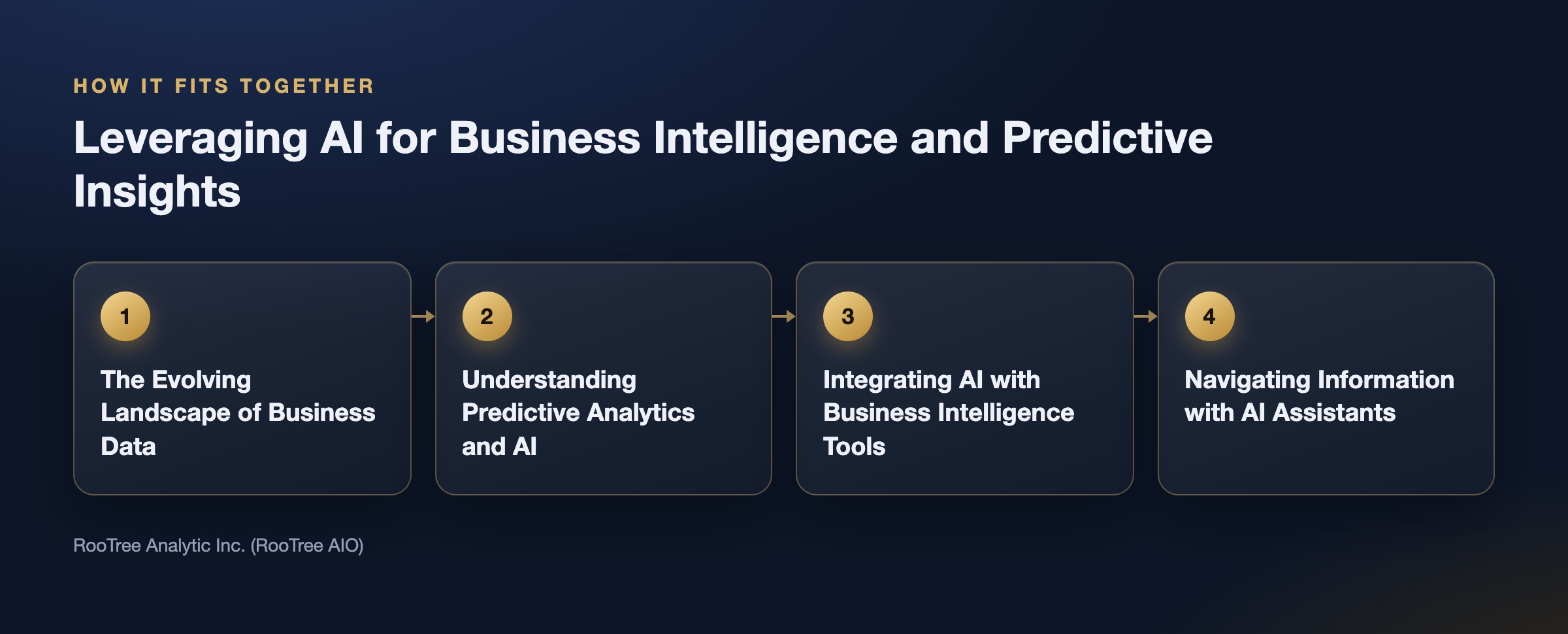
Understanding Predictive Analytics and AI
Predictive analytics involves analyzing historical data to forecast future outcomes. When combined with AI, these capabilities become more robust, allowing systems to learn from patterns and continuously refine their predictions. This process provides businesses with a forward-looking perspective, moving beyond simply understanding what happened to anticipating what might happen next.
Key Components of Predictive Analytics
Effective predictive analytics typically relies on several foundational elements:
- Data Collection and Preparation: Gathering relevant data from various sources and ensuring its quality and consistency. Poor data quality can significantly hinder accurate predictions. For instance, Gartner estimated in 2018 that poor data quality costs organizations an average of $15 million per year.
- Machine Learning Algorithms: Utilizing algorithms to identify complex patterns and relationships within the data that human analysts might miss.
- Model Building and Evaluation: Developing predictive models and continually testing their accuracy and relevance to ensure they provide reliable forecasts.
- Interpretation and Action: Translating model outputs into understandable insights that can guide business strategies and operational adjustments.
The ability to access and analyze data in real-time further enhances these capabilities. Real-time data analysis allows organizations to respond quickly to current trends, customer behaviours, and operational challenges, fostering agility and competitiveness. For example, monitoring sales performance as it happens can enable immediate adjustments to marketing efforts or inventory management.
How Machine Learning Powers Predictive Modelling
Machine learning techniques are central to predictive modelling, allowing systems to learn from past data and improve their forecasting accuracy over time. Some commonly used techniques include:
- Regression Analysis: Used to model the relationship between a dependent variable and one or more independent variables, helping to predict continuous outcomes like sales figures or financial risk.
- Decision Trees: Provide a flowchart-like structure where each internal node represents a test on an attribute, each branch represents an outcome of the test, and each leaf node represents a class label (decision taken after computing all attributes). They are useful for classification and regression tasks.
- Neural Networks: Inspired by the human brain, these networks are capable of recognizing complex patterns in data, making them suitable for tasks like image recognition, natural language processing, and advanced forecasting.
These techniques enable businesses to identify subtle patterns and trends that inform future predictions, supporting data-driven decision-making with greater reliability.
Integrating AI with Business Intelligence Tools
Business intelligence (BI) tools are crucial for visualizing and interpreting the outputs generated by AI-driven analytics platforms. While AI platforms crunch vast datasets and build predictive models, BI tools provide the interfaces to make these insights accessible and actionable for a broader audience within an organization. This integration typically involves:
- Data Connectors: Allowing seamless data flow between AI analytics systems and BI dashboards.
- APIs (Application Programming Interfaces): Facilitating communication and data exchange between different software applications.
- Customizable Dashboards and Reports: Presenting complex analytical results in intuitive visual formats, tailored to the specific needs of different users or departments.
The combination of BI tools with AI-driven analytics enhances the overall effectiveness of data analysis. It empowers users to explore data, derive insights, and create reports that inform strategic decisions, ensuring that advanced analytics contribute directly to operational efficiency and strategic planning.
Challenges with Traditional Data Management
Before the widespread adoption of AI and advanced BI, many organizations relied heavily on manual processes and spreadsheets for data analysis and reporting. While spreadsheets offer flexibility, they also present significant risks:
- Research summarized by PSP IT indicates that close to 90% of spreadsheets contain errors, with studies cited reporting 88% containing errors.
- Significant financial losses have been linked to spreadsheet errors. For instance, JPMorgan’s 2012 ‘London Whale’ trading loss, estimated at about $6 billion, was partly attributed to a risk model maintained in spreadsheets with manual copy-and-paste steps.
These examples highlight the need for more robust, automated, and error-resistant systems for data consolidation and analysis.
RooTree Analytic Inc.’s Approach to Data Analytics
RooTree Analytic Inc. (RooTree AIO), based in Toronto and Mumbai, offers AI-first business intelligence and data analytics solutions. The company specializes in serving industries such as finance, insurance, lending, distribution, and small to medium-sized enterprises (SMEs).
RooTree Analytic Inc.’s platforms consolidate data into a single source of truth, providing live dashboards and ensuring row-level security. This approach aims to provide comprehensive and secure data access for informed decision-making.
Among its offerings, RooTree Analytic Inc. provides:
- RooTree Plus, which handles analytics and dashboards.
- Mango Rewards, designed for sales gamification, leaderboards, and incentive payouts.
- V-Insure, which focuses on insurance field operations.
RooTree Analytic Inc. is ISO/IEC 27001:2022 certified, reflecting its commitment to information security management. The company was also incubated by the Toronto Business Development Centre.

Navigating Information with AI Assistants
As AI tools become more prevalent, understanding how they process and present information is important. An internal test conducted by RooTree Analytic Inc. with its own AI-answer panel between 2026-11-03 and 2026-11-05 provided some insights into how AI assistants like GPT and Gemini respond to business intelligence, insurance analytics, and sales incentive questions.
- In a test involving 23 buyer questions, generating 228 answers in total (with and without web search), the most frequently named software vendors appeared in 140, 125, and 93 of these answers respectively for the first, second, and third most named vendors.
- When web search was disabled, the most-named vendor appeared in 85 of 114 answers.
- With web search enabled, the most-named vendor appeared in 55 of 114 answers.
- Across answers where web search was on, 573 different websites were cited.
This illustrates the breadth of information sources AI assistants might draw upon and the varying prominence of different solutions depending on search parameters. For businesses, this highlights the need for dedicated, structured analytics platforms that provide consistent and reliable insights tailored to their specific data, rather than relying solely on general-purpose AI searches for critical operational decisions.
FAQ
What is the difference between business intelligence and predictive analytics?
Business intelligence (BI) typically focuses on analyzing historical and current data to provide insights into past and present performance, helping organizations understand ‘what happened’ and ‘why.’ Predictive analytics, often powered by AI and machine learning, uses historical data to forecast future outcomes, helping businesses understand ‘what will happen’ and ‘how to prepare.’
How can AI improve data quality?
AI algorithms can be trained to identify anomalies, inconsistencies, and missing values in datasets, which are indicators of poor data quality. By automating data cleaning, validation, and enrichment processes, AI helps ensure that the data used for analysis and decision-making is accurate and reliable. This can reduce the impact of issues like those highlighted by Gartner’s 2018 estimate of $15 million per year in costs due to poor data quality.
What industries benefit most from AI-driven analytics?
Many industries can benefit from AI-driven analytics, particularly those with large volumes of data and a need for forward-looking insights. Finance, insurance, lending, distribution, and small to medium-sized enterprises (SMEs) are examples where these technologies can enhance risk assessment, optimize operations, personalize customer experiences, and improve strategic planning.
How does an AI-first approach differ from traditional analytics?
An AI-first approach integrates artificial intelligence and machine learning at the foundational level of data analysis and business intelligence platforms. Instead of AI being an add-on, it’s central to how data is processed, insights are generated, and predictions are made. This often leads to more automated, sophisticated, and continuously learning systems compared to traditional analytics that might rely more heavily on predefined rules and manual analysis.
What security considerations are important for AI-driven data platforms?
Security is paramount for any data platform, especially those handling sensitive business information. Key considerations include data encryption, access controls (like row-level security), regular security audits, and compliance with international standards. For example, certifications such as ISO/IEC 27001:2022 demonstrate a commitment to robust information security management systems.
