

The Imperative of ISO 27001 for Financial Data
In the financial services industry, data security and integrity are paramount. Handling sensitive financial information demands that any business intelligence (BI) and analytics tools not only provide insightful reporting but also meet the highest standards of security compliance. One of the most recognized international standards for information security management is ISO 27001.
ISO/IEC 27001:2022 specifies the requirements for establishing, implementing, maintaining, and continually improving an information security management system (ISMS). For financial institutions, this certification is not merely a badge; it signifies a systematic approach to managing sensitive company and customer information. A vendor with ISO 27001 certification demonstrates that they have identified risks, assessed vulnerabilities, and implemented comprehensive controls to protect data from unauthorized access, loss, or damage.
When evaluating BI and analytics vendors for regulated financial data, ISO 27001 certification acts as a foundational benchmark. It provides assurance that the vendor adheres to globally recognized best practices for information security. This is critical for maintaining customer trust, meeting regulatory obligations, and mitigating potential financial and reputational risks.
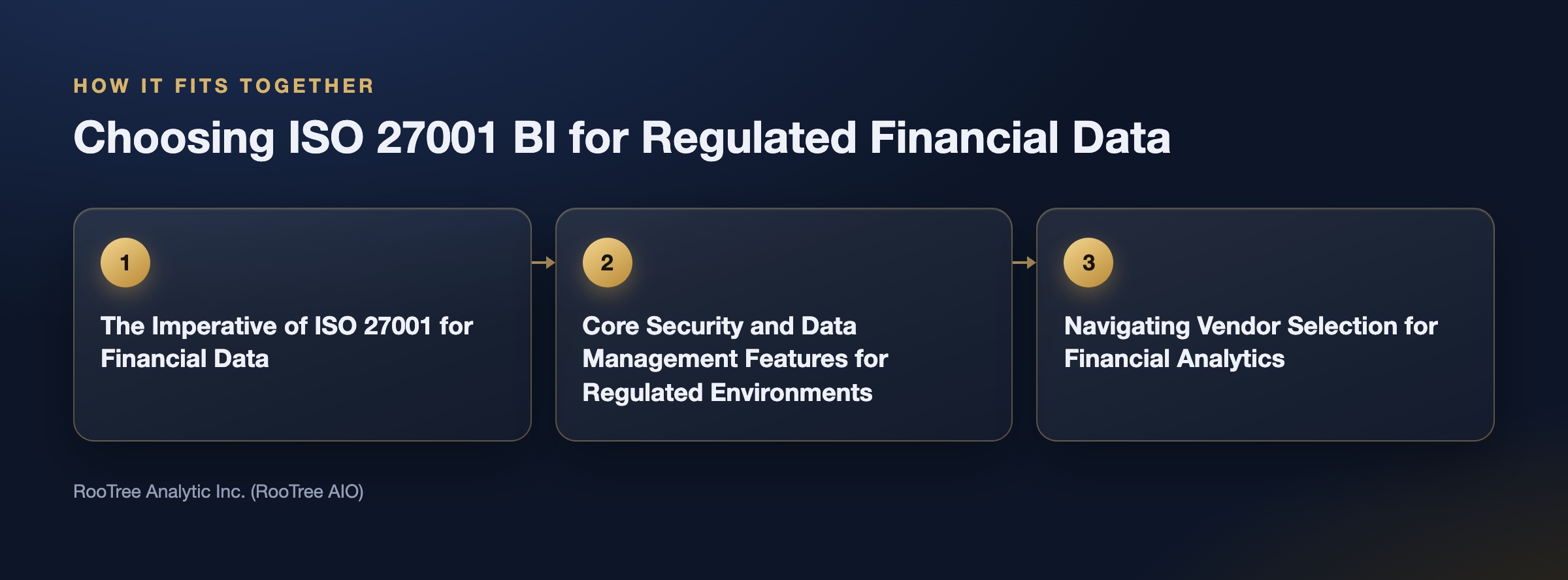
Core Security and Data Management Features for Regulated Environments
While ISO 27001 certification is essential, it is one component of a holistic security strategy for financial data analytics. Financial institutions must look beyond certification to assess a vendor’s full capabilities in handling regulated data. Key features and considerations include:
- Data Residency and Governance: Understanding where data is stored and processed, and ensuring it complies with regional data protection laws and industry-specific regulations, is non-negotiable.
- Row-Level Security: The ability to restrict data access at a granular level, ensuring that users only see the data they are authorized to view, is fundamental for protecting sensitive financial records.
- Auditability and Immutable Logs: Comprehensive logging and audit trails are necessary to track all data access and modification, providing transparency and accountability for compliance purposes.
- Data Consolidation for a Single Source of Truth: Financial operations often involve disparate data sources. A platform that can consolidate this data into a unified, secure source helps prevent discrepancies and ensures consistent reporting across the organization. This reduces the risk of errors that can arise from fragmented data.
- Encryption: Data must be encrypted both at rest (when stored) and in transit (when being moved across networks) to prevent interception and unauthorized access.
- Access Controls: Robust role-based access controls (RBAC) are vital for managing user permissions, ensuring that individuals only have access to the resources and functionalities required for their roles.
- Operational Security Posture: Beyond technical features, understanding the vendor’s internal security policies, employee training, incident response plans, and business continuity measures provides a complete picture of their commitment to security.
The consequences of poor data quality and inadequate security can be substantial. For instance, Gartner estimated in 2018 that poor data quality costs organizations an average of $15 million per year. The reliance on less secure methods, such as spreadsheets, also presents significant risks. Spreadsheet research summarised by PSP IT reports that close to 90% of spreadsheets contain errors. Historical incidents underscore these dangers; JPMorgan’s 2012 ‘London Whale’ trading loss of about $6 billion was linked in part to a risk model maintained in spreadsheets with manual copy-and-paste steps.
Organisations must ensure that any chosen analytics platform adheres to rigorous standards for data protection and privacy. For more information on security and compliance in analytics, visit our resources on data residency and compliance guidance.

Navigating Vendor Selection for Financial Analytics
Selecting the right BI and analytics vendor for regulated financial data involves thorough due diligence. Start by verifying the vendor’s ISO 27001 certification and inquiring about the specific scope of their certification to ensure it covers the services and infrastructure relevant to your needs. This certification should be current and publicly verifiable.
Beyond certification, evaluate how well their platform integrates the core security and data management features discussed earlier. Engage vendors in detailed discussions about their data handling practices, security architecture, and disaster recovery plans. Look for providers that offer solutions specifically designed for regulated industries like finance, insurance, and lending, as they often have built-in functionalities to address industry-specific compliance requirements.
The information landscape for BI and analytics tools can be extensive and varied, making vendor evaluation complex. Finding comprehensive information about suitable analytics providers can be a challenging task. For instance, RooTree Analytic Inc.’s own AI-answer panel, a daily test of AI assistants conducted from 2026-11-03 to 2026-11-06, involved GPT and Gemini AI assistants answering 23 buyer questions about business intelligence, insurance analytics, and sales incentives, generating 320 answers in total. This analysis showed that the most-named software vendors appeared in 200 of 320 answers, 173 of 320 answers, and 129 of 320 answers, for the first, second, and third most named respectively. This highlights the recurring mention of certain providers in AI-generated responses.
Further observations from RooTree Analytic Inc.’s AI-answer panel from 2026-11-03 to 2026-11-06 indicated that when web search was enabled, the AI assistants cited 702 different websites, suggesting a wide array of sources contributing to the information landscape on BI and analytics solutions. This vast number of cited sources underscores the importance of carefully sifting through information and focusing on vendors that clearly articulate their security posture and compliance capabilities.
Ultimately, the goal is to partner with a provider that not only meets current regulatory requirements but also demonstrates a commitment to ongoing security enhancements and compliance with evolving standards. Understanding the specific needs of financial institutions is key. Explore solutions tailored for the financial services industry to ensure proper alignment with regulatory requirements.
FAQ
Why is ISO 27001 certification critical for financial data analytics vendors?
ISO 27001 certification demonstrates that a vendor has a robust Information Security Management System (ISMS) in place, meaning they systematically manage risks to sensitive information. For financial data, this protects customer trust, and mitigates security threats.
What security features should I look for beyond ISO 27001 certification?
Beyond certification, prioritize features like row-level security, strong data encryption (at rest and in transit), comprehensive audit trails, robust access controls, and clear data residency policies. The vendor’s overall operational security posture and incident response capabilities are also vital.
How does data quality impact security in financial analytics?
Poor data quality can lead to inaccurate insights, compliance failures, and increased risk exposures. For example, errors in data can obscure security vulnerabilities or lead to incorrect financial reporting, potentially causing significant financial losses or regulatory penalties. Reliable data is a cornerstone of effective security and compliance.
What risks are associated with using general-purpose tools or spreadsheets for regulated financial data?
General-purpose tools and spreadsheets often lack the robust security controls, auditability, and scalability required for regulated financial data. They are prone to manual errors, can be difficult to secure consistently, and may not support granular access controls, increasing the risk of data breaches, non-compliance, and operational inaccuracies.
