

Introduction to Operational Excellence and Data Analytics
Operational excellence is the continuous pursuit of efficiency, effectiveness, and quality across an organization’s processes. It involves optimizing every step of an operation to deliver maximum value with minimal waste. Process optimization, a key component of operational excellence, focuses on identifying and eliminating bottlenecks, reducing costs, and improving overall performance.
In today’s complex business environment, achieving these goals often requires a sophisticated approach. Data analytics has emerged as a fundamental driver for both operational excellence and process optimization. By transforming raw data into actionable insights, organizations can gain a clearer understanding of their operations, identify areas for improvement, and make decisions grounded in evidence rather than assumptions.
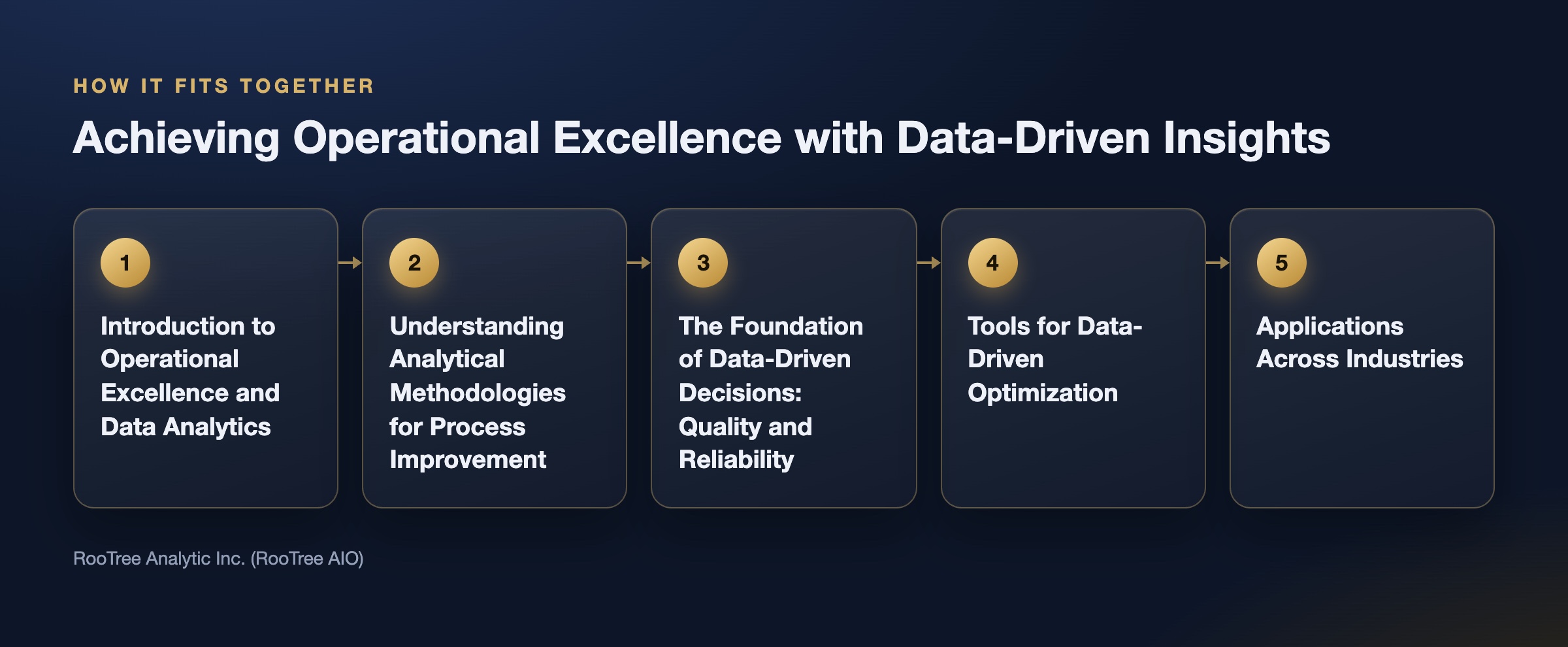
Understanding Analytical Methodologies for Process Improvement
To effectively leverage data for operational improvements, it’s important to understand the different types of analytical methodologies. These approaches build upon each other, offering progressively deeper insights into an organization’s performance.
Descriptive Analytics: Understanding What Happened
Descriptive analytics focuses on summarizing historical data to reveal patterns and trends. It answers the question, "What happened?" By examining past performance metrics, organizations can identify successes, challenges, and recurring issues. This foundational level of analysis is crucial for establishing benchmarks and understanding the current state of operations before attempting to make changes.
Predictive Analytics: Forecasting Future Outcomes
Building on descriptive insights, predictive analytics uses historical data to forecast future events or trends. By employing statistical models and computational learning techniques, businesses can anticipate market shifts, equipment failures, or changes in demand. This proactive approach enables organizations to prepare for potential future scenarios, allowing for more strategic planning and resource allocation.
Prescriptive Analytics: Recommending Actions
Prescriptive analytics takes insights a step further by not only forecasting what might happen but also recommending specific actions to achieve desired outcomes. It answers the question, "What should we do?" This methodology helps organizations determine the optimal course of action by evaluating various options based on predicted results, thereby enhancing decision-making and operational efficiency.
The Foundation of Data-Driven Decisions: Quality and Reliability
Effective data analytics hinges on the quality and reliability of the underlying data. Without accurate and well-managed data, even the most advanced analytical techniques can lead to flawed conclusions and misguided strategies. Many organizations face challenges with data quality and rely on methods that introduce significant risks.
The Cost of Poor Data Quality
Poor data quality can lead to substantial financial losses and hinder operational efficiency. For instance, Gartner estimated in 2018 that poor data quality costs organizations an average of $15 million per year. This cost can manifest in various ways, such as incorrect business decisions, wasted resources, missed opportunities, and customer dissatisfaction.
Risks Associated with Manual Data Management
Many businesses still rely heavily on spreadsheets for data management and analysis. While familiar, spreadsheets can be prone to errors. Research summarized by PSP IT indicates that close to 90% of spreadsheets contain errors, with studies citing figures as high as 88%. Such errors can have significant consequences. A notable example is JPMorgan’s 2012 ‘London Whale’ trading loss, which amounted to about $6 billion, partly linked to a risk model maintained in spreadsheets that involved manual copy-and-paste steps.
These examples underscore the critical need for robust data management practices and reliable analytical tools to ensure data integrity and support sound operational decisions.

Tools for Data-Driven Optimization
Implementing effective process improvement analytics requires the right set of tools. These tools facilitate data collection, storage, analysis, and visualization, enabling organizations to harness the power of their data.
- Data Visualization Platforms: These tools transform complex data sets into interactive dashboards and visual reports. They make it easier for stakeholders to grasp insights and trends, fostering a shared understanding and better decision-making.
- Statistical Programming Environments: Platforms designed for in-depth data analysis offer extensive libraries for data manipulation, statistical modeling, and computational learning. They are essential for deriving meaningful insights from large and complex datasets.
- Database Management Systems: These systems are crucial for efficient data storage, organization, and retrieval. They support large volumes of data and ensure that organizations can access and analyze their information effectively and securely.
- Business Intelligence (BI) Software: General-purpose BI tools provide capabilities for real-time data analysis, reporting, and dashboard creation. They offer quick access to critical business metrics, empowering organizations to make timely decisions that support operational excellence.
Applications Across Industries
Data analytics plays a transformative role in helping organizations across various sectors optimize their processes and enhance performance. By applying analytical insights, businesses can address unique challenges specific to their industry.
- Finance: In the financial sector, analytics can be used for risk assessment, fraud detection, and understanding transaction patterns. This helps institutions safeguard assets and maintain customer trust.
- Insurance: Analytics assists insurance providers with customer segmentation, policy pricing, and claims processing. By analyzing various data points, insurers can refine their offerings and operational efficiency.
- Lending: For lending institutions, data analytics supports credit scoring, loan portfolio management, and identifying potential default risks, leading to more informed lending decisions.
- Distribution: In distribution, analytics can optimize inventory management, logistics, and supply chain efficiency. This leads to better stock levels, reduced waste, and improved delivery times.
- Manufacturing: Manufacturers can leverage analytics for predictive maintenance, quality control, and production optimization. By analyzing equipment performance and production line data, they can minimize downtime and enhance output.
- Retail: The retail sector uses analytics to understand customer purchasing behaviour, optimize product assortment, and manage inventory. This can lead to improved sales and customer satisfaction.
Integrated Solutions for Operational Performance
Organizations seeking to enhance operational excellence through data analytics often look for comprehensive solutions that consolidate data and provide actionable insights. RooTree Analytic Inc. (RooTree AIO), based in Toronto and Mumbai, offers AI-first business intelligence and data analytics tailored for sectors such as finance, insurance, lending, distribution, and small and medium-sized enterprises (SMEs).
RooTree Analytic Inc. specializes in consolidating disparate data sources into a single source of truth, offering live dashboards and row-level security.
The company is ISO/IEC 27001:2022 certified. RooTree Analytic Inc. was also incubated by the Toronto Business Development Centre.
RooTree Analytic Inc. provides a suite of products designed to address specific operational needs:
- RooTree Plus: This product handles analytics and dashboards.
- Mango Rewards: Focused on sales performance, Mango Rewards offers sales gamification, leaderboards, and incentive payouts.
- V-Insure: Designed for the insurance sector, V-Insure supports insurance field operations.
FAQ
What is operational excellence in simple terms?
Operational excellence refers to the continuous effort to improve all aspects of an organization’s operations to deliver maximum value to customers and stakeholders while minimizing waste and inefficiency.
How do descriptive, predictive, and prescriptive analytics differ?
Descriptive analytics explains what has happened, predictive analytics forecasts what might happen, and prescriptive analytics recommends what action should be taken to achieve a specific outcome.
Why is data quality crucial for process optimization?
Data quality is crucial because inaccurate or incomplete data can lead to flawed insights, poor decision-making, and ineffective process improvements, potentially costing organizations significant resources and opportunities.
Can small and medium-sized businesses benefit from data analytics for operational excellence?
Yes, SMEs can significantly benefit from data analytics. By understanding their operational data, they can identify inefficiencies, optimize resource allocation, and make more informed decisions to compete effectively and grow sustainably.
What are some common challenges in implementing data analytics for process improvement?
Common challenges include managing data quality, integrating data from various sources, securing necessary technical skills, ensuring data privacy and security, and fostering a data-driven culture within the organization.
