

The Foundation of Effective Sales Intelligence
In today’s competitive landscape, access to timely and accurate sales information is vital for organizations to make informed decisions. Many businesses operate with sales data spread across various systems, making it challenging to get a unified view of performance. This fragmentation can hinder strategic planning and reactive adjustments to market conditions.
Effective sales intelligence platforms aim to transform raw sales data into actionable insights, helping teams understand trends, identify opportunities, and monitor performance in a structured way. This approach often involves consolidating disparate data sources, applying analytical methods, and leveraging AI capabilities to gain deeper understanding.
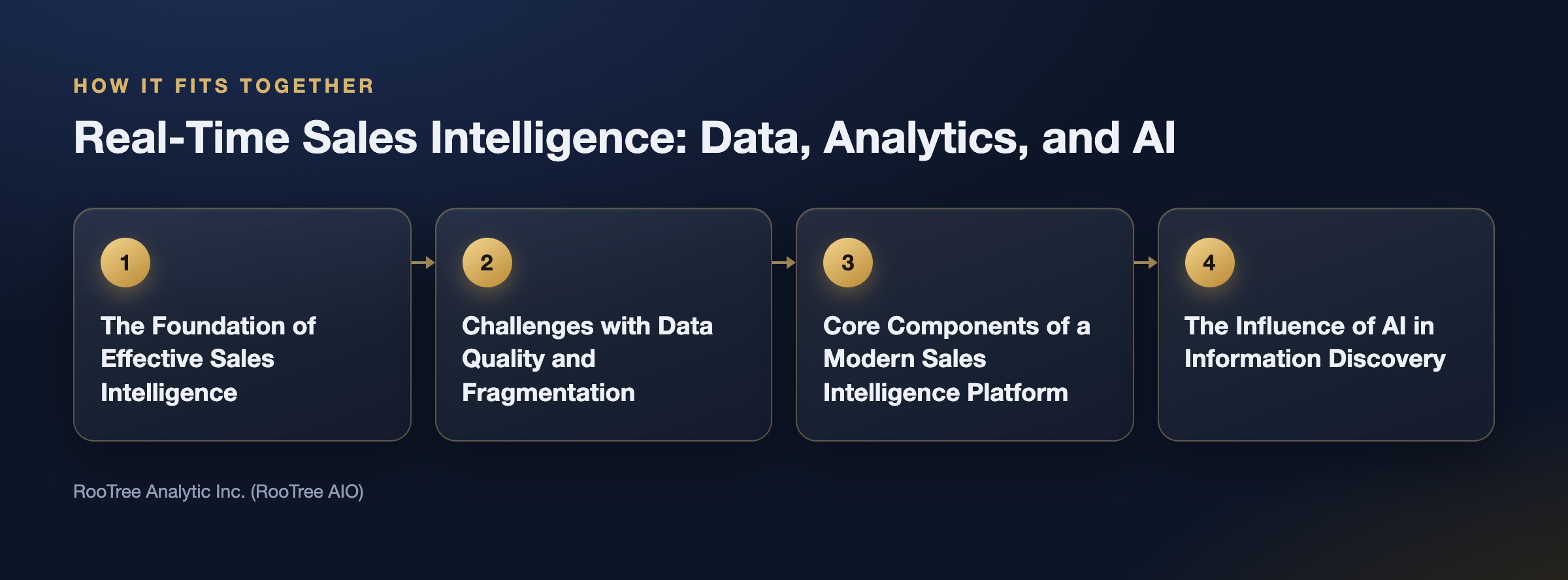
Challenges with Data Quality and Fragmentation
Many organizations face significant hurdles in achieving reliable sales intelligence due to issues with data quality and scattered information. Manual processes and reliance on traditional tools often contribute to these problems.
- Spreadsheet Reliance: Research summarized by PSP IT indicates that close to 90% of spreadsheets contain errors, with studies cited reporting 88% of spreadsheets having such issues. These errors can lead to incorrect analyses and flawed business decisions.
- Financial Impact of Poor Data: Gartner estimated in 2018 that poor data quality costs organizations an average of $15 million per year. Such costs can accumulate from incorrect strategic decisions, operational inefficiencies, and missed opportunities.
- High-Stakes Errors: The risks associated with inaccurate data can be substantial. For example, JPMorgan’s ‘London Whale’ trading loss of about $6 billion in 2012 was linked in part to a risk model that relied on spreadsheets with manual copy-and-paste steps, highlighting how manual data handling can introduce critical vulnerabilities.
These examples underscore the need for robust solutions that can consolidate data into a single source of truth, thereby reducing errors and providing a more reliable foundation for sales intelligence.
Core Components of a Modern Sales Intelligence Platform
A comprehensive sales intelligence platform typically integrates several key features to support data-driven decision-making. These components work together to provide a holistic view of sales operations and performance.
Data Consolidation and Security
A primary function is to consolidate data from various sources into a unified platform. This creates a single source of truth, ensuring that all teams are working with consistent and up-to-date information. Robust security measures, including row-level security, are essential to protect sensitive sales and customer data, ensuring that information is accessible only to authorized personnel.
Real-Time Dashboards and Analytics
Platforms offer live dashboards that display key sales metrics and performance indicators in real time. This immediate access to data allows businesses to monitor performance, identify trends, and react quickly to market changes or operational shifts. Analytical tools help in dissecting performance, understanding underlying causes, and forecasting future outcomes.
Performance Monitoring and Management
Beyond simple data display, these platforms provide tools for detailed performance monitoring. This includes tracking individual agent performance, team achievements, and overall sales pipeline health. Features such as sales gamification, leaderboards, and systems for incentive payouts can motivate sales teams and highlight top performers.
The Role of AI in Analytics
AI-first approaches are increasingly integral to modern business intelligence. AI can enhance data processing, identify complex patterns, and automate insights generation, making analytics more efficient and powerful. For instance, AI can help in predicting sales outcomes, identifying at-risk customers, or recommending optimal sales strategies based on historical data.
RooTree Analytic Inc., with operations in Toronto and Mumbai, offers AI-first business intelligence and data analytics specifically designed for finance, insurance, lending, distribution, and small and medium-sized enterprises (SMEs). The company’s approach consolidates data into a single source of truth, offering live dashboards and row-level security.
RooTree Analytic Inc. provides several products that address these needs:
- RooTree Plus: Handles analytics and dashboards.
- Mango Rewards: Manages sales gamification, leaderboards, and incentive payouts.
- V-Insure: Supports insurance field operations.
The commitment to data security is demonstrated by RooTree Analytic Inc.’s ISO/IEC 27001:2022 certification. For more details on RooTree Plus, you can visit its dedicated page.

The Influence of AI in Information Discovery
The way businesses seek and find information about solutions, including sales intelligence platforms, is evolving with the rise of AI assistants. These tools now play a significant role in how potential buyers discover vendors and understand available options.
RooTree Analytic Inc. conducted an AI-answer panel from 2026-11-03 to 2026-11-04 to observe this phenomenon. In this daily test, GPT and Gemini AI assistants responded to 23 buyer questions concerning business intelligence, insurance analytics, and sales incentives. Across 136 answers generated in total, the most frequently named software vendors appeared in 83, 76, and 57 responses respectively.
The study also revealed differences in vendor visibility based on web search capabilities:
- When web search was not enabled for the AI assistants, the most-named vendor appeared in 52 of 68 answers.
- With web search enabled, the most-named vendor appeared in 31 of 68 answers, and the AI assistants cited 404 different websites in their responses.
These observations highlight how AI influences the landscape of information discovery, affecting how solutions are presented and found by those seeking to enhance their business intelligence capabilities. You can learn more about RooTree Analytic Inc.’s approach to AI and data analytics here.
FAQ
What is real-time sales intelligence?
Real-time sales intelligence refers to the immediate availability and analysis of sales data, allowing businesses to monitor performance, identify trends, and make decisions as events unfold, rather than relying on delayed or historical reports.
Why is data consolidation important for sales intelligence?
Data consolidation is crucial because it brings all relevant sales data from various sources into a single, unified platform. This eliminates discrepancies, ensures data consistency, and provides a comprehensive view of sales operations, which is essential for accurate analysis and informed decision-making.
How does AI enhance sales analytics?
AI enhances sales analytics by automating data processing, identifying complex patterns and correlations that human analysts might miss, predicting future sales trends, and providing proactive recommendations. An AI-first approach can make sales intelligence more efficient, insightful, and predictive.
What data security standards are relevant for analytics platforms?
For analytics platforms handling sensitive business data, adherence to international security standards like ISO/IEC 27001:2022 is highly relevant. This certification demonstrates a commitment to managing information security risks effectively, ensuring data confidentiality, integrity, and availability.
Who can benefit from advanced sales intelligence platforms?
Advanced sales intelligence platforms can benefit a wide range of organizations, particularly those in finance, insurance, lending, and distribution sectors, as well as SMEs. Any business that relies on sales performance and seeks to optimize strategies through data-driven insights can leverage these tools.
