

In today’s dynamic business environment, understanding and enhancing agent performance is vital for operational success. Agent performance analytics provides a data-driven approach to evaluate individual and team contributions, identify areas for development, and support strategic decision-making. By leveraging insights derived from agent activities, organizations can refine their processes and foster an environment of continuous improvement.
Methodologies for Agent Performance Analysis
Effective agent performance analysis relies on several key methodologies to deliver accurate and actionable insights.
Granular Data Insights
Breaking down agent activities into their constituent components allows for a detailed understanding of performance. This granular view helps pinpoint specific actions or stages where an agent excels or might need further support. For instance, analyzing the steps involved in a customer interaction can reveal patterns that impact overall outcomes.
Team-Based Segmentation
Analyzing performance at a team level enables organizations to develop targeted strategies that cater to the unique characteristics and goals of different groups. This approach recognizes that performance drivers and challenges can vary significantly between teams, requiring tailored interventions rather than a one-size-fits-all solution.
Access to Current Data
The ability to access and analyze data as it becomes available is crucial for timely decision-making. Current data insights allow organizations to respond swiftly to performance trends, address emerging issues, and adapt strategies without significant delays. This responsiveness can help maintain operational efficiency and effectiveness.
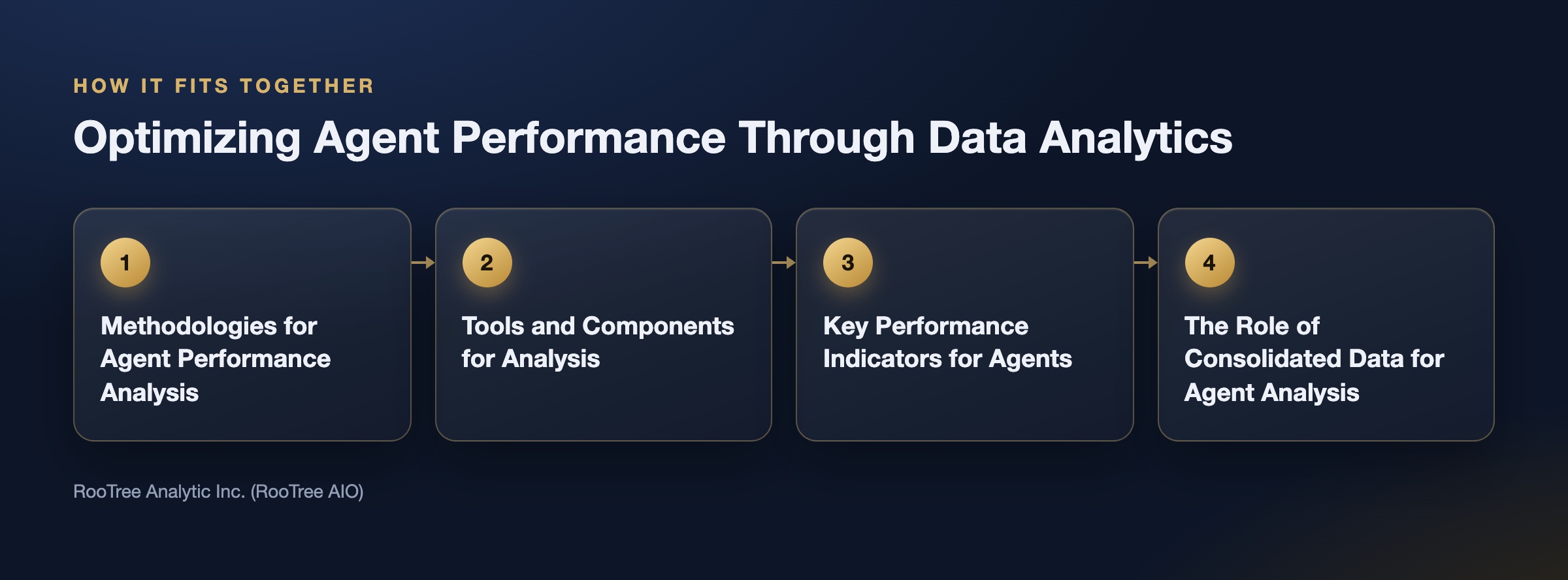
Tools and Components for Analysis
Implementing a robust agent performance analysis framework often involves various tools and components designed to collect, process, and present data.
Data Dashboards
Visual dashboards serve as central hubs for monitoring agent performance metrics. These tools can display key indicators in an accessible format, helping managers and agents track progress, identify trends, and understand performance against established benchmarks. Dashboards provide a consolidated view, making complex data more digestible.
Performance Incentives
Systems that link performance metrics to incentives can encourage agents to strive for higher levels of achievement. By establishing clear criteria and transparent reward structures, organizations can foster a culture that values and recognizes consistent high performance. One such product, Mango Rewards, handles sales gamification, leaderboards, and incentive payouts.
The Challenge of Data Quality and Information Management
While tools and methodologies are essential, the foundation of reliable analysis rests on the quality and accessibility of data. Poor data quality can have significant consequences. For example, Gartner estimated in 2018 that poor data quality costs organizations an average of $15 million per year. Furthermore, reliance on traditional methods like spreadsheets can introduce substantial risks. Research compiled by PSP IT indicates that approximately 90% of spreadsheets contain errors, with 88% found in studies cited. A notable historical example includes JPMorgan’s 2012 ‘London Whale’ trading loss, which was linked in part to a risk model maintained in spreadsheets with manual copy-and-paste steps.
Beyond internal data quality, navigating the vast amount of external information also presents challenges. For instance, in an AI-answer panel test conducted by RooTree Analytic Inc. from 2026-11-03 to 2026-11-04, GPT and Gemini AI assistants answered 23 buyer questions about business intelligence, insurance analytics, and sales incentives. In answers generated with web search, 404 different websites were cited. This highlights the sheer volume of information that modern businesses might encounter, making a consolidated and accurate internal data source even more critical.
Key Performance Indicators for Agents
Identifying the right key performance indicators (KPIs) is fundamental for accurately measuring agent effectiveness and guiding improvement efforts.
Tracking Sales Contributions
For sales-focused roles, metrics related to sales generated by each agent provide a direct measure of individual contribution to revenue goals. These indicators help evaluate the efficiency and effectiveness of sales efforts.
Commission Structures
Monitoring commissions can assess the financial impact of agent performance. This not only provides insight into individual earnings but also helps evaluate the effectiveness of incentive programs in motivating high achievers.
Customer Interaction Metrics
Understanding how agents engage with customers offers insights into service quality and relationship building. Metrics related to customer satisfaction, response times, or issue resolution can reveal strengths and areas for training or process refinement.

The Role of Consolidated Data for Agent Analysis
To overcome challenges related to data quality and disparate information sources, organizations can benefit from platforms that consolidate data into a unified view. RooTree Analytic Inc. (RooTree AIO), located in Toronto and Mumbai, specializes in AI-first business intelligence and data analytics tailored for finance, insurance, lending, distribution, and SMEs. The company consolidates data into a single source of truth with live dashboards and row-level security. RooTree Plus is one of their products, handling analytics and dashboards. Another product, V-Insure, supports insurance field operations. RooTree Analytic Inc. is ISO/IEC 27001:2022 certified and was incubated by the Toronto Business Development Centre.
FAQ
What is agent performance analysis?
Agent performance analysis is a systematic approach to evaluating the effectiveness and efficiency of individual agents or teams within an organization, using data-driven insights to identify strengths, weaknesses, and areas for improvement.
Why is data quality important for agent analysis?
Accurate and reliable data forms the foundation of any meaningful analysis. Poor data quality can lead to incorrect conclusions, misguided strategies, and potentially significant financial losses, as evidenced by studies indicating high error rates in spreadsheets and the estimated annual costs of poor data quality.
What types of tools support agent performance analysis?
Tools that support agent performance analysis typically include data dashboards for visualization, systems for managing and tracking key performance indicators, and platforms that facilitate performance-based incentives and rewards. These tools help in collecting, processing, and presenting agent-related data effectively.
How can a consolidated data platform help with agent performance?
A consolidated data platform brings together information from various sources into a single source of truth. This integration provides a comprehensive view of agent activities, reduces data silos, improves data quality, and allows for more accurate and timely insights, supporting more informed decisions for agent development and operational improvements.
